Proposal strategy
Is This Upwork Job Worth Applying To? An 8-Signal Decision Checklist
A practical, evidence-led checklist for deciding whether an Upwork job deserves your connects, proposal time, and attention.

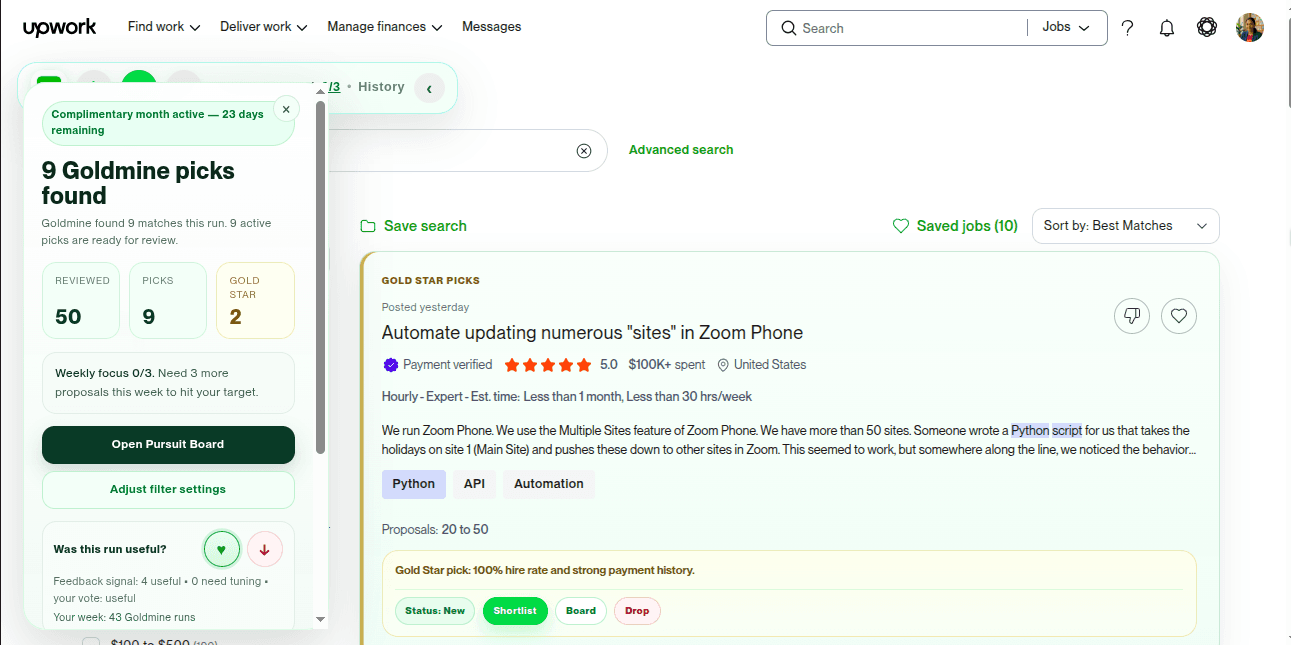
An Upwork job can look attractive in ten seconds. Deciding whether it deserves a proposal takes longer.
That distinction matters because a proposal is not free. Upwork says the number of Connects required can vary by job and can change while the post is live. A serious proposal also consumes time, attention, research, and the emotional energy of waiting for a response.
The goal is not to reject every imperfect listing. It is to decide which opportunities deserve a closer look before you spend.
Start with fit, not client statistics
The strongest client history cannot rescue a job you are poorly positioned to win.
Before inspecting hire rate or spend, ask:
- Can I describe relevant proof in the first few lines of my proposal?
- Do I understand the requested outcome well enough to offer a credible approach?
- Does the budget support the quality of work the client appears to expect?
- Would winning this project move my freelance business in a useful direction?
If the answer is “no” across most of these questions, skip the listing. A disciplined freelancer protects connects by filtering for fit first, then client quality.
The 8-signal Upwork job checklist
No signal below proves that a client is good, bad, serious, or unserious. Treat each one as evidence that changes how much investigation the opportunity deserves.
1. The job is specific enough to price and pursue
A useful job post usually gives you enough context to understand the deliverable, desired outcome, constraints, or decision criteria.
Specific does not mean long. A concise client who clearly states the problem may be easier to work with than a client who provides three pages of unfocused instructions.
Clarity of scope
- Encouraging
- A concrete outcome, useful context, and enough detail to propose a sensible next step.
- Look closer
- Generic requirements, contradictory expectations, or a large unpaid discovery burden.
- Use it for
- Deciding whether you can write a specific proposal instead of a generic application.
2. Your proof matches the client’s real problem
The best listing is not necessarily the one with the biggest budget. It is the one where your experience creates an obvious reason to interview you.
Look for a match between the job and evidence you can show:
- A similar outcome you delivered
- Domain knowledge that reduces the client’s risk
- A relevant portfolio sample
- A credible method for handling the difficult part
When your proof is weak, the proposal often becomes a promise. When your proof is strong, the proposal becomes a decision aid.
3. The client’s hire rate has enough context
Upwork defines a client’s hire rate as how often they hire a freelancer or agency after posting a job. A 50% hire rate means the client hired for half of the jobs they posted.
That makes hire rate useful, but not decisive.
A long-established client with many posts and a persistently low hire rate deserves scrutiny. A new client with one post has almost no historical sample. A client may also post multiple roles for one initiative or close a requirement outside the original post.
Client hire rate
- Encouraging
- A repeated history of converting job posts into hires.
- Look closer
- A low rate across many posts, especially when paired with weak spend or vague listings.
- Use it for
- Estimating whether the client usually follows through—not predicting whether they will hire you.
Source: Upwork’s explanation of client hire rate.
4. Client spend and work history support the opportunity
Previous spend is evidence that a client has successfully paid freelancers through Upwork. It can also help you understand the kinds of work, rates, and relationships the client has supported before.
Use history to ask better questions:
- Has the client paid for work similar to this?
- Are previous contract values consistent with the current budget?
- Do previous freelancer relationships appear substantial or extremely fragmented?
- Is there evidence of repeat hiring?
Do not automatically reject new clients. Every strong client had a first Upwork job. New clients simply require more weight on scope quality, communication, verification, and your own risk controls.
5. Payment verification is reassuring, not a guarantee
Upwork tells clients that verifying billing information helps prevent scams and makes freelancers more eager to apply. That makes payment verification a useful trust signal.
But it does not prove that the scope is healthy, the budget is fair, or the client will be easy to work with. Likewise, an unverified billing method can mean a new client has not finished setup yet.
Sources: Upwork on posting a job and billing verification and Upwork on unverified billing methods.
6. The budget and rate are economically credible
A budget should be judged against the work—not against your excitement about the opportunity.
Check whether the visible budget or rate can reasonably support:
- The requested scope
- Communication and revision time
- Specialist expertise
- Delivery risk
- Upwork fees and your business costs
Some clients use placeholder budgets and expect discussion. That can be acceptable when the scope is credible and your proposal can establish the right commercial frame. But a deeply unrealistic budget paired with demanding scope is usually a signal to move on.
7. Current job activity still leaves room for you
Freshness and visible job activity help you decide whether the opportunity is still alive.
If the client has already hired, is interviewing many candidates, or has not returned for a long period, the expected value of a new proposal may be lower. It may still be worth applying when your fit is unusually strong—but the bar should rise.
Upwork’s proposal insights can show eligible freelancers information such as bid ranges, client activity, and proposal trends. Even without that feature, use every visible activity signal as timing context rather than as a verdict.
Source: Upwork proposal insights.
8. The opportunity deserves follow-through after the proposal
Many freelancers treat submission as the finish line. It is only a stage.
A job is more valuable when you can define what you will do next:
- Revisit when the client becomes active
- Check whether hiring activity changed
- Refine the proof point you want to lead with
- Prepare a thoughtful response if the client replies
- Learn from the result whether you win or lose
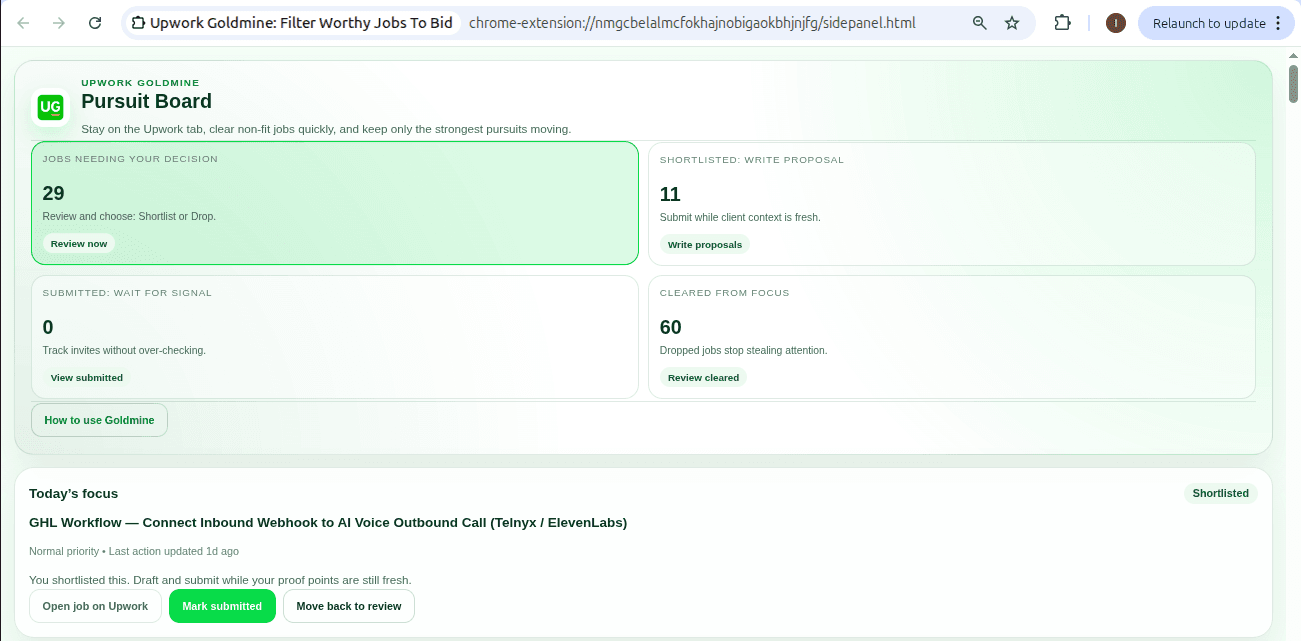
This is where a simple pursuit board becomes useful. It turns an attractive listing into a managed business opportunity.
A two-minute decision score
Use this lightweight score before drafting:
| Question | Score |
|---|---|
| I have directly relevant proof | +2 |
| The outcome and scope are understandable | +2 |
| The economics are credible | +2 |
| Client history supports follow-through | +1 |
| Payment is verified or the new-client context is credible | +1 |
| Current activity suggests the opportunity is still open | +1 |
| I can state a specific proposal angle | +1 |
| Scope or expectations contain a serious warning sign | -3 |
| I would be applying mainly because I feel anxious or idle | -2 |
8–10: Strong candidate for a careful proposal.
5–7: Investigate the weak points before deciding.
Below 5: Usually skip and preserve your attention.
This is not a universal formula. Adjust the weights for your niche, risk tolerance, and business stage. The value comes from making your reasoning explicit.
What not to do
- Do not reject every new client.
- Do not assume high spend guarantees a good engagement.
- Do not apply merely because the post is fresh.
- Do not let a large budget hide poor fit.
- Do not spend Connects to relieve anxiety.
- Do not automate away your final judgment.
Build your own evidence loop
Upwork’s stats and trends are designed to help freelancers understand activity such as proposals, profile views, and client interactions. Use your own results to improve the checklist.
Every month, review:
- Which proposal types produced interviews
- Which client histories led to healthy contracts
- Which warning signs you ignored
- Which new-client bets worked
- Which niches justified higher proposal effort
Your best filtering system is not someone else’s list of rules. It is a disciplined interpretation of platform evidence plus your own outcomes.
Sources: Upwork on stats and trends and Upwork on Connects.
Editorial note and limitations
This guide is an independent decision framework written by the product builder behind Upwork Goldmine. It is based on visible platform signals, primary Upwork documentation, product-building experience, and practical workflow design.
Upwork can change its interface, metrics, features, and policies. No checklist or extension can determine whether a client will hire you, whether a job is legitimate, or whether a proposal will succeed. Review each opportunity yourself and follow Upwork’s current rules and safety guidance.