Connects strategy
How to Find Serious Upwork Clients Before Spending Connects
A practical 2026 checklist for finding serious Upwork clients before spending Connects, using visible client signals, job activity, fit, budget realism, and pursuit discipline.


Most freelancers do not waste Connects because they are lazy.
They waste Connects because Upwork makes weak opportunities look close enough to strong ones when you are tired, anxious, or trying to stay consistent.
A serious Upwork client is not simply a client with a big budget. It is a client whose visible behavior, job post, economics, and timing suggest that your proposal has a real chance of becoming a useful conversation.
That is the whole discipline: spend Connects like capital, not like panic.
Why this matters more in 2026
The old Upwork habit was simple: search, skim, apply, repeat.
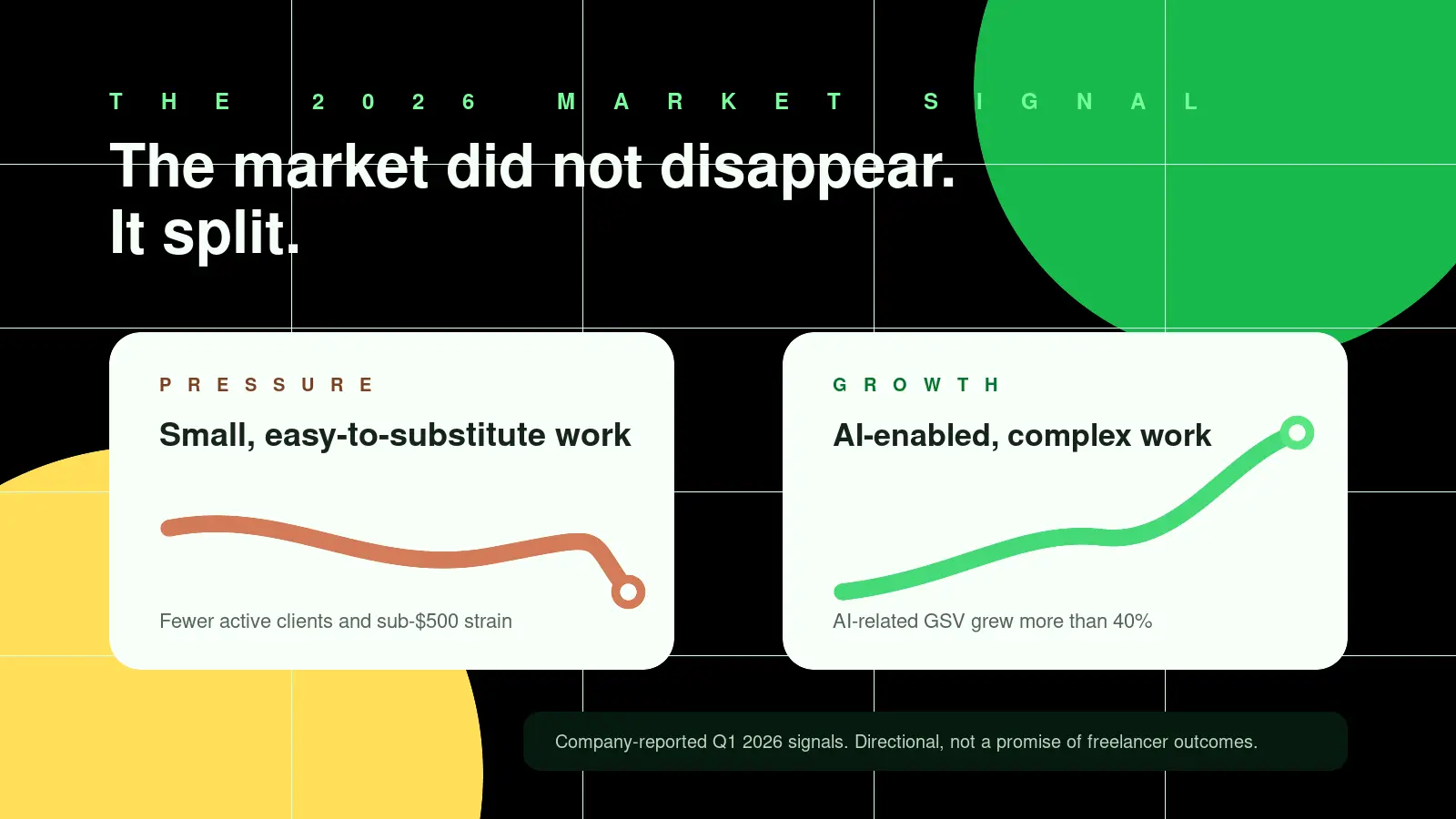
That habit is weaker now. AI can help more freelancers produce acceptable proposals quickly. Clients see more polished words. Freelancers feel more pressure to respond fast. But the business fundamentals have not changed: a better proposal still starts with a better decision about the client.
Upwork's own Connects guidance is clear about this. Upwork calls Connects a valuable resource and recommends reviewing whether the job matches your skills and availability, whether the client has hired, how many freelancers they plan to hire, client history and feedback, and current activity such as proposals and interviews before applying.
Source: Upwork on understanding and using Connects.
That is not just platform advice. It is a freelance-business principle.
The 4-layer serious-client test
Use this before writing the proposal. It is intentionally simple enough to apply in two minutes.
1. Client signal
Has this client shown credible hiring behavior, spend, feedback, verification, or repeat work patterns?
2. Job signal
Is the post clear enough to price, scope, and respond to without pretending you understand more than you do?
3. Market signal
Is the job still alive, or are you entering late into heavy proposal and interview activity?
4. Fit signal
Can you show proof, judgment, and a specific first step better than a generic AI-polished applicant?
The mistake is treating one signal as a verdict.
Payment verified does not guarantee seriousness. A high budget does not guarantee quality. A new client is not automatically bad. A low proposal count is not automatically an opportunity. A serious decision comes from the pattern.
9 signals to check before spending Connects
1. The job post explains an outcome, not only a task
Weak task posts say things like “Need website,” “Write blogs,” or “Need VA.”
Stronger posts usually give you some context about the business problem, desired result, constraints, audience, timeline, or decision criteria. They do not need to be long. A short post can be serious if it gives you enough to make a credible judgment.
Scope clarity
- Encouraging
- The client explains the outcome, context, audience, constraint, or success condition.
- Look closer
- The post is generic, contradictory, or so broad that you would need unpaid discovery just to understand it.
- Use it for
- Deciding whether you can write a specific proposal instead of another template.
Ask yourself:
- Can I describe the likely deliverable?
- Can I identify the risk or hard part?
- Can I suggest a sensible first step?
- Can I tell whether the budget is even close to realistic?
If not, preserve your Connects unless another signal is unusually strong.
2. The client has hired before, or the new-client context is credible
Hiring history is one of the most useful signals because it shows whether the client has converted job posts into actual contracts.
But use it carefully.
An established client with many posts and few hires deserves scrutiny. A new client with no history needs a different test: is the scope clear, is the budget sensible, is payment verification present or likely to follow, and does the post sound like a real business need?
Upwork says established clients, in general, are clients who have hired and spent on Upwork, though it does not disclose the exact criteria for some Connects rewards.
Source: Upwork on Connects rewards and established clients.
3. Hire rate has enough sample size to mean something
Hire rate can be useful, but it is easy to misuse.
If a client posted 2 jobs and hired once, the percentage looks simple but the sample is tiny. If a client posted 80 jobs and rarely hires, that is more meaningful. A low hire rate across many posts may suggest the client browses, reposts, changes direction, or hires outside the original listing.
Hire rate
- Encouraging
- The client repeatedly turns job posts into hires, especially in work similar to yours.
- Look closer
- Many posts with low hiring follow-through, especially when paired with vague scope or weak spend.
- Use it for
- Estimating follow-through probability, not predicting your outcome.
Treat hire rate as a follow-through signal. Do not use it as a moral judgment about the client.
4. Spend history matches the work being requested
Client spend helps you understand whether the client has paid for work through Upwork and what kind of engagements they tend to support.
The useful question is not “Is total spend high?”
The useful questions are:
- Has this client paid for similar work before?
- Are previous contracts close to the current scope?
- Do past jobs suggest repeat relationships or one-off churn?
- Is the current budget aligned with what they historically pay?
High spend can still hide a poor-fit job. Low spend can still be a serious new opportunity. Look for consistency between what they ask now and what they have supported before.
5. Payment verification supports trust, but does not replace judgment
Payment verification is reassuring because it lowers one basic trust concern. It does not prove the project is good, the client is fair, or the scope is healthy.
Use it this way:
| Payment state | Practical interpretation |
|---|---|
| Verified + clear scope | Encouraging, especially with good history |
| Verified + vague scope | Still risky; ask whether you can frame the work clearly |
| Unverified + new client + clear scope | Possible, but apply with caution and follow Upwork safety rules |
| Unverified + vague scope + unrealistic promise | Usually not worth your Connects |
The point is not to fear every unverified client. The point is to avoid letting one visible trust badge override the rest of the evidence.
6. The budget is commercially believable
A serious client may negotiate. A serious client may start with a placeholder. A serious client may not know the exact price yet.
But a serious opportunity should still have some commercial logic.
Check whether the budget or hourly range can support:
- the actual deliverable,
- communication and revision time,
- specialist judgment,
- platform fees and your business costs,
- the risk you are accepting.
If the scope asks for senior work but the budget signals commodity pricing, you need a strong reason to continue. Sometimes the right move is to pass. Sometimes the right move is to apply only if your proposal can reframe the scope into a smaller, credible first milestone.
7. Current activity tells you whether the job is still worth entering
A job can be good and still be poor timing.
Look at visible activity before spending Connects:
- How many proposals are already there?
- Is the client interviewing?
- Has the client already hired?
- Has the client viewed or returned to the post recently?
- Does the job appear stale?
Upwork specifically tells freelancers to assess job activity because many proposals or ongoing interviews may reduce your chances.
Source: Upwork on managing Connects.
This does not mean “never apply late.” It means your bar should rise when the timing is worse. If you are late, your fit and opening line must be unusually strong.
8. The proposal count changes your strategy, not only your decision
Many freelancers use proposal count as a yes/no filter. That is too crude, especially now that AI-assisted proposals can make many jobs reach 20-50 proposals quickly.
High proposal volume does not automatically mean “skip.” It means the client has attention, the competition is noisy, and your proposal needs a stronger reason to exist. If the client history, scope, budget, timing, and your fit are all strong, a high-proposal job can still be worth applying to.
Use it as a strategy signal:
| Proposal pressure | What it means |
|---|---|
| Low proposals | Move fast if fit and client quality are strong |
| Medium proposals | Apply only with a specific proof angle |
| High proposals | Apply only if you are clearly differentiated; consider visibility tactics only if affordable |
| Interviews already active | Apply only if the job is unusually aligned with your proof |
A serious client can receive many proposals. The question is whether you can still be the most useful option.
Boosting a proposal may help with visibility, but it should never be used to rescue a weak-fit application. Treat boosting as an optional visibility expense after the opportunity passes your signal test, not as a replacement for client selection.
9. You can explain your fit without sounding generic
This is the final gate.
Before spending Connects, write the first sentence in your head. If it sounds like anyone could say it, the job may not be worth applying to yet.
Useful openings usually contain at least one of these:
- a relevant result you have produced,
- a similar business problem you understand,
- a risk the client has not fully named,
- a first step that reduces uncertainty,
- a specific tradeoff the client should consider.
In 2026, this matters more because AI can generate fluent proposals. Fluency is no longer enough. Serious clients need evidence of judgment.
The 10-point serious-client scorecard
Use this when you are tempted to apply quickly.
| Signal | Score |
|---|---|
| The work fits proof I can show | +2 |
| Scope and desired outcome are understandable | +2 |
| Client history shows hiring follow-through or credible new-client context | +1 |
| Spend history or budget supports the work | +1 |
| Payment verification or trust context is acceptable | +1 |
| Current activity suggests the job is still alive | +1 |
| Proposal pressure still leaves room for my differentiation | +1 |
| I can write a specific first sentence | +1 |
| Scope has a serious warning sign | -3 |
| I am applying mainly because I feel anxious, idle, or behind | -2 |
8-10: worth a careful proposal.
5-7: inspect the weak points before deciding.
Below 5: usually save your Connects.
This score is not magic. It is a pause button. Its job is to stop emotional bidding and force commercial clarity.
A manual workflow you can use today
- Search Upwork with your normal niche keywords.
- Open only jobs where the title and preview suggest possible fit.
- Check client history, spend, verification, hire behavior, and job activity.
- Score the opportunity before opening your proposal editor.
- Write the first sentence mentally.
- Apply only if the first sentence can be specific.
- Save promising jobs you are not ready to apply to yet.
- Review saved jobs later for activity changes before spending.
This is slower than panic-applying. It is faster than wasting a week on weak proposals.
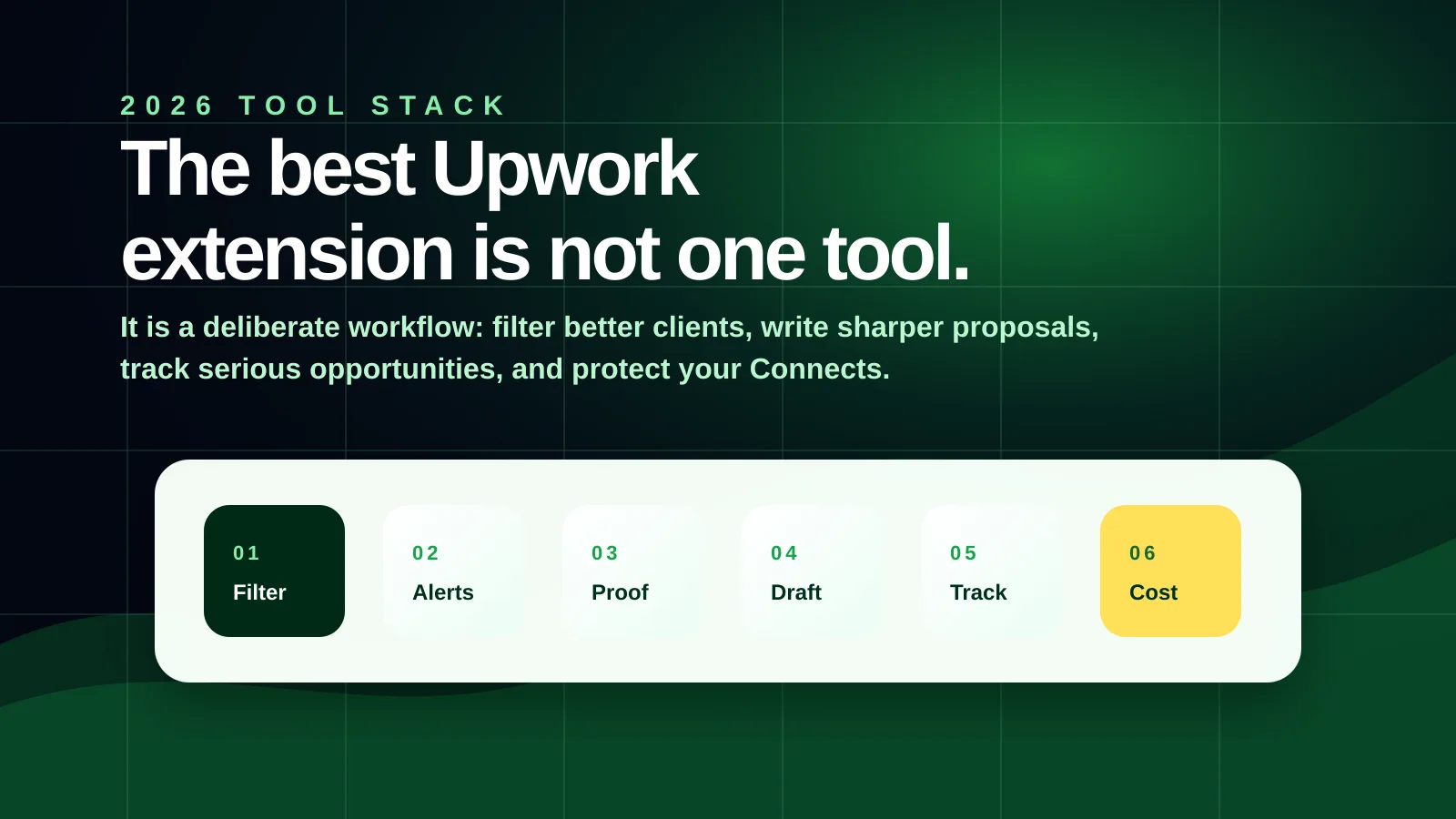
For one job, this checklist is easy. The real challenge is consistency: doing it across dozens of visible jobs without getting mentally tired, emotionally reactive, or sloppy. That is where a repeatable system matters. You can use the manual workflow above, or use a focused filtering workflow like Goldmine to make the same decision discipline easier to repeat.
How Upwork Goldmine fits into this system
You can do everything above manually. In fact, you should understand the manual method first.
Upwork Goldmine exists because doing it repeatedly across visible search results is tedious. Its role is not to promise jobs or replace judgment. Its role is narrower: help freelancers reduce noisy Upwork search results into a smaller set of opportunities worth reviewing, then keep those opportunities organized after the first scan.
That fits two stages of the freelance value chain:
| Stage | Manual habit | Goldmine role |
|---|---|---|
| Client filtering | Check signals before spending Connects | Surface stronger-looking jobs from visible results |
| Pursuit organization | Save, revisit, decide, follow up | Keep shortlisted jobs in a focused pursuit pipeline |
Goldmine is independent and not affiliated with Upwork. It works with visible page information and your authenticated product access. It cannot know private client intent, guarantee interviews, or decide whether you should apply.
Answers to common questions
How do I find good clients on Upwork?
Look for a pattern: clear scope, credible budget, hiring history or credible new-client context, payment/trust signals, active job behavior, and a strong fit with your proof. Do not use one metric alone.
How do I use Upwork Connects to find valuable clients?
Treat Connects as a limited business budget. Spend them only when the client signal, job signal, timing, and your fit are strong enough to justify a careful proposal.
How do I get clients on Upwork without Connects?
For open Marketplace jobs, Connects are generally part of submitting proposals. To reduce dependence on Connects, improve your profile for invitations, build repeat-client relationships, use referrals, publish credible proof, and avoid wasting Connects on weak-fit posts.
How do I get 100% JSS on Upwork?
There is no shortcut. A high Job Success Score comes from the quality of client outcomes and relationship signals over time. The practical connection to this article is simple: choosing better-fit clients reduces avoidable delivery and communication risk.
Should I apply to new Upwork clients with no hiring history?
Sometimes. New clients can be serious. Raise the bar on scope clarity, budget realism, trust signals, and your own risk controls. Do not reject them automatically, but do not treat them like proven repeat buyers either.
Should I boost proposals to serious clients?
Boosting is a visibility decision, not a substitute for fit. Consider it only after the opportunity passes your client-signal test, you can write a differentiated proposal, and the extra Connects are affordable for your current freelance budget.
Final rule
You do not need to apply to more jobs to become more consistent.
You need a more consistent decision system.
When you find a serious client, strong timing, credible economics, and a clear proof match, spend the Connects and write carefully. When those signals are missing, save your attention. Your freelance business does not grow because every job gets a proposal. It grows because the right jobs get your best thinking.